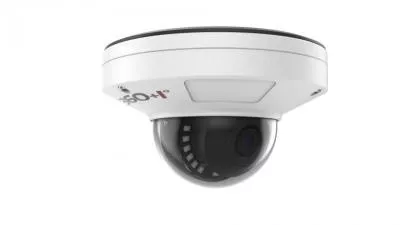
The 8BBWNN-27135 camera is equipped with an IMX 415 sensor as standard. Thanks to Starvis technology, the camera has high photosensitivity with less noise. It is equipped with adaptive infrared illumination, providing illumination at a distance of up to 30 m. and a 2.7-13.5 mm motorized lens, which allows you to get high-quality images at night.
The camera supports video encoding in H.264, H.265 (MJPG on demand) formats, providing at least 2 video streams. At the same time, the cameras support a wide dynamic range of up to 100dB and a 4-zone ROI.
The camera provides Ethernet (RJ45, including POE IEEE 802.3), Audio-in, Power-in (DC12V connector), as well as Power-out and Hard-reset interfaces. Optional – RS485 Alarm in\out, Audio-out.
Power is supplied via a 12V (DC) connector, or via an IEEE 802.3 PoE interface with a high voltage range of ±25%.
The principle of operation of all IP cameras is as follows: the image of the observed object, passing through the lens lenses and the IR filter, focuses on the CMOS sensor, which in turn converts the optical image into an electrical digital signal.
Then the signal in the form of electrical pulses is sent to the camera processor, which, according to the LINUX-based software built into the camera, converts the signal into the appropriate electronic photo or video format. The digital image and sound generated by the processor can be processed in various ways and stored digitally on an internal semiconductor recording device (SD card), or transmitted to a local network as a digital stream. The location of the save and the format are determined by the user.
Background information
IP video cameras differ from analog AHD video cameras and are electronic computing complexes with software and other modules. They include a SoC (System On Chip) that combines processor, memory, and hardware modules. The SoC ensures the compactness and functionality of the device. It can also contain video stream decoders/encoders and hardware accelerators for image processing. Security cameras use memory to store software, including the operating system, drivers, and applications. It also stores the camera settings and configuration. Without memory, the SoC cannot function. Memory access requires special hardware and a programmer for flashing. Memory is an integral part of an IP camera and its absence leads to malfunction.
Firmware is the software code that controls the camera's hardware, including the SoC and sensor. It determines the camera's functionality, including the resolution, quality, and speed of the video. The IP camera does not work without firmware, unlike analog AHD cameras. SDK (Software Development Kit) is a set of software tools for developing software for an IP camera. It allows you to use SoC capabilities, create customizable solutions, and connect to other devices and networks. The SDK also includes drivers and libraries for working with various operating systems and platforms.
The software is an integral part of the operation of an IP camera. The camera cannot function without the software, and the software depends on camera components such as SoC and memory chips. IP cameras should be considered as software and hardware complexes where all the elements are interconnected. Using imported software without certification and open source code can lead to undocumented features and threats to network security. The installation of such cameras in government institutions and strategic facilities poses a threat to national security.
The actual and complete characteristics of the equipment are indicated in the technical data sheets for the equipment, confirmed by the signature and seal of the manufacturer.
Working hours: 8:00 - 18:00
Toll-free call in Russia